

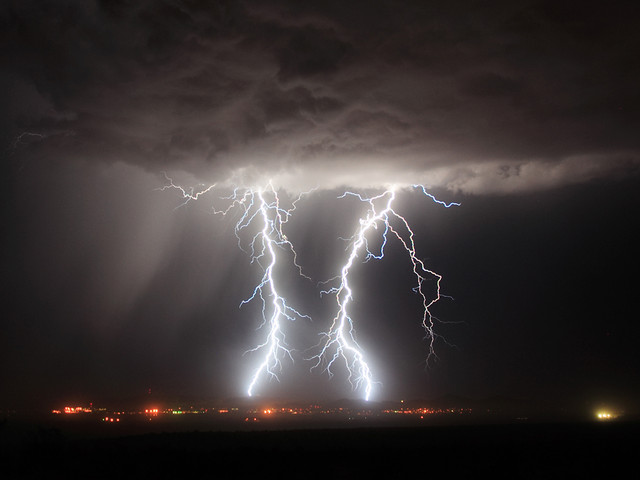

Weather describes the condition of the atmosphere at a particular place and time. It includes factors such as temperature, humidity, rainfall, wind speed, cloud cover, atmospheric pressure, and visibility. These conditions can change within minutes or remain relatively stable for several hours, depending on local and regional atmospheric patterns.
Unlike climate, which describes long-term patterns over many years, weather focuses on short-term atmospheric conditions. A city may experience a hot afternoon followed by thunderstorms in the evening, while another location only a few hundred kilometres away could remain dry. This difference is one reason local forecasts are important for everyday planning.
Modern forecasting combines observations from weather stations, satellites, radar systems, aircraft, ocean instruments, and computer models. These technologies help meteorologists identify developing systems and estimate how atmospheric conditions may evolve.
How Weather Forecasts Are Created
A forecast begins with observations collected from many locations. Ground stations measure temperature, pressure, wind, humidity, and precipitation. Satellites provide information about cloud formations, moisture, storms, and large atmospheric systems, while radar can track precipitation and severe weather in considerable detail.
This information is fed into numerical prediction models. These computer systems use mathematical equations to represent atmospheric processes and calculate possible future conditions. Meteorologists then examine model output, compare different forecast scenarios, and consider local geography before producing public forecasts.
Forecasting is not simply a matter of predicting whether it will rain tomorrow. Atmospheric systems interact across large areas, and small differences in initial conditions can affect later outcomes. As the forecast period becomes longer, uncertainty generally increases.
Key Elements Used to Describe Atmospheric Conditions
Several measurements help explain what people experience outdoors. Temperature indicates how warm or cold the air is, while humidity describes the amount of moisture present in the atmosphere. Wind is usually reported using speed and direction, and precipitation covers rain, snow, sleet, or other forms of falling water or ice.
Cloud cover also matters because clouds influence sunlight, temperature, and rainfall. Atmospheric pressure provides another important signal. Changes in pressure can accompany the movement of weather systems, although pressure alone does not determine what conditions people will experience.
Here is a simple overview of common forecast elements:
| Forecast Element | What It Tells You | Why It Matters |
|---|---|---|
| Temperature | How warm or cold the air is | Clothing and outdoor planning |
| Humidity | Amount of moisture in the air | Comfort and heat perception |
| Wind | Air movement and direction | Travel, outdoor work, and storms |
| Precipitation | Expected rain, snow, or other precipitation | Activities and transport |
| Cloud Cover | Amount of sky covered by clouds | Sunlight and temperature |
| Visibility | How clearly distant objects can be seen | Driving and aviation |
Understanding these measurements makes forecasts easier to interpret instead of relying only on a single temperature number.
Why Local Weather Can Differ From Nearby Areas
Geography has a major influence on atmospheric conditions. Mountains can force moist air upward, increasing precipitation on one side while producing drier conditions on another. Coastal areas may experience moderating effects from nearby oceans, while inland locations can experience larger temperature swings.
Urban areas can also behave differently from surrounding rural regions. Buildings, roads, vehicles, and other infrastructure absorb and release heat, creating localized temperature differences. Elevation is another factor because temperature and atmospheric pressure generally change with altitude.
For this reason, a regional forecast may not perfectly represent conditions at a specific neighbourhood, airport, hill station, or rural location. Local observations can provide useful context when planning outdoor activities.
How to Read a Daily Forecast More Effectively
Many people focus primarily on the expected high temperature, but a useful forecast contains much more information. Looking at hourly conditions can reveal when rainfall is most likely, when temperatures will peak, and whether winds are expected to strengthen.
The probability of precipitation is another commonly misunderstood forecast element. A percentage generally represents the likelihood of measurable precipitation for a defined location and forecast period. It should not automatically be interpreted as the percentage of the day that will be rainy or the percentage of an area that will receive rain.
For practical planning, consider several forecast elements together:
- Check temperature alongside humidity and wind.
- Look at hourly precipitation when timing matters.
- Pay attention to official severe-weather alerts.
- Compare current observations with the latest forecast.
This approach gives a more complete picture than relying on one number or symbol.
Weather Changes and Seasonal Patterns
Seasonal changes occur because Earth receives different amounts of solar energy throughout the year as it moves around the Sun and because its axis is tilted. This produces broad seasonal patterns, although local geography and atmospheric circulation determine how those patterns appear in different regions.
In India, seasonal conditions can vary substantially between regions. The southwest monsoon brings widespread rainfall to many parts of the country, while northern and interior areas can experience significant temperature differences between summer and winter. Coastal regions often have different temperature patterns from inland cities.
Seasonal forecasts can help people understand broad trends, but they should not be treated as precise predictions for every individual day. Conditions within a season can still vary considerably.
The Role of Severe Weather Alerts
Forecasting becomes particularly important when potentially hazardous atmospheric events develop. These may include thunderstorms, cyclones, intense rainfall, heatwaves, cold waves, strong winds, flooding conditions, or reduced visibility.
Official alerts usually communicate both the expected hazard and the affected areas. People should pay attention to the issuing authority, warning level, timing, and recommended precautions rather than relying on social media posts or unverified messages.
For severe conditions, practical preparation can include securing loose outdoor objects, avoiding unnecessary travel during dangerous conditions, keeping communication devices charged, and following local emergency guidance.
Technology Is Changing Modern Forecasting
Advances in computing, satellite observation, radar, and artificial intelligence are improving the way atmospheric data is processed. High-resolution models can represent local geographic features more effectively, while improved observation networks provide more information about current atmospheric conditions.
Machine-learning techniques are also being explored for forecasting and weather-related data analysis. These systems can identify patterns in large datasets and assist traditional numerical models. However, forecasting remains a complex scientific task because the atmosphere is constantly changing and contains many interacting processes.
For users, the practical benefit is that forecast services can increasingly provide more localized information, frequent updates, radar imagery, and alerts through digital platforms.
Weather Information for Everyday Decisions
Reliable forecasts influence many ordinary activities. Farmers use atmospheric information when planning irrigation, planting, harvesting, and protection against extreme conditions. Travellers check forecasts before road journeys and flights, while construction teams consider wind and precipitation before scheduling outdoor work.
The information is equally useful for simple personal decisions. Choosing appropriate clothing, planning exercise, organizing an outdoor event, or deciding when to travel can all benefit from checking current conditions and short-range forecasts.
Weather information can also help reduce unnecessary disruption. Checking updated forecasts before leaving home is especially useful when storms, heavy rainfall, extreme heat, or strong winds are possible.
Weather Forecast Accuracy and Uncertainty
Forecast accuracy depends on several factors, including the forecast period, quality of observations, atmospheric complexity, and the scale of the event. Short-range forecasts are generally more useful for specific local decisions, while longer-range outlooks are better suited to understanding broad trends.
No forecast should be interpreted as a guarantee. Conditions can develop differently from the initial prediction, particularly during rapidly changing situations. Forecast providers may update their information as new observations become available.
When conditions are important or potentially dangerous, checking the latest forecast and official alerts shortly before taking action is sensible.
Conclusion
Weather affects transportation, agriculture, business, travel, health, outdoor activities, and everyday routines. Understanding temperature, humidity, precipitation, wind, cloud cover, pressure, and forecast uncertainty makes atmospheric information much easier to use.
Modern forecasting combines ground observations, satellites, radar, computer models, and meteorological expertise to provide increasingly detailed guidance. Still, changing atmospheric conditions mean forecasts should be viewed as informed predictions rather than guarantees. By checking current conditions, understanding forecast terminology, and following official alerts during severe events, people can make more informed decisions about daily activities and seasonal planning.